


Trends Shaping the Global DC EV Charging Station Market
Aug 27, 2026
Global Charging Infrastructure
Trends Shaping the Global DC EV Charging Station Market
The DC EV charging station market is moving beyond simply installing more chargers. Buyers now have to plan for higher vehicle voltage, shared site power, open backend integration, regional connector requirements, commercial-vehicle charging and measurable service availability.
The most important market shift is from isolated charging cabinets to coordinated charging infrastructure. Charger hardware, utility capacity, management software, payment systems, vehicle schedules and maintenance support increasingly need to be specified as one operating system.
Market Direction
Fast-Charging Deployment Is Outpacing the Earlier Market Structure
The IEA reported that more than 1.3 million public charging points were added worldwide in 2024, increasing the global stock by more than 30%. Public chargers had doubled compared with 2022.
This expansion does not mean every market needs the same charger. China, Europe, North America and emerging EV markets differ in connector adoption, distribution voltage, payment expectations, certification and vehicle charging behavior.
- Urban sites need higher connector density and efficient power sharing.
- Highway sites prioritize rapid turnover and charger availability.
- Fleet depots plan charging around routes and departure times.
- Commercial-property owners require access and billing integration.
- Importers must match chargers to local electrical and communication standards.
Eight Market Trends
What Is Changing in DC Charging Procurement
Higher Charging Power
Public and fleet projects are moving from basic fast charging toward 120, 180, 240 kW and higher site configurations. The correct rating still depends on vehicle acceptance, dwell time and available grid capacity.
Wider Output Voltage
Support for vehicles using higher-voltage battery platforms is increasing demand for chargers with a wider DC output range. Buyers should verify voltage and current coverage, not only cabinet power.
Shared Power Architecture
Multi-connector stations increasingly allocate available power according to active vehicle demand. This can improve asset use where not every bay requires peak power simultaneously.
Open Backend Integration
OCPP support is becoming a procurement requirement for networks that need centralized monitoring, authorization, transaction records and third-party management-system integration.
Fleet and Truck Charging
Commercial vehicles are creating new demand for depot charging, scheduled energy delivery, heavy-duty cables and eventually megawatt-class corridor charging.
Grid-Constrained Design
Transformer capacity, demand charges and connection lead times are making managed charging, phased deployment and energy-storage integration more relevant.
Availability as a Buying Criterion
Operators are examining connector availability, session-start success, fault diagnosis, spare parts and service response instead of treating installation as project completion.
Regional Compliance
Connector standards, electrical certification, accessibility, payment and data requirements vary by destination. Export projects require market-specific configuration.
Power Selection
Charger Ratings Are Increasing, but Maximum Power Is Not Always the Best Investment
A charger delivers only the power permitted by the vehicle, charging curve, cable, thermal condition and site power limit. Project economics depend on useful energy delivery rather than the number printed on the cabinet.
| Power Range | Common Deployment | Main Planning Question | Market Direction |
|---|---|---|---|
| 30–40 kW | Dealerships, workplaces, destination sites and service facilities | Is moderate DC charging sufficient for the available dwell time? | Remains relevant where grid capacity and vehicle turnover are limited. |
| 60–90 kW | Urban public charging, commercial parking and light fleets | Can one cabinet support the expected daily session volume? | Provides a practical balance between charging speed and site input. |
| 120–160 kW | Busy public stations, transport hubs and fleet depots | Should available power be divided across two connectors? | Increasingly used for multi-vehicle commercial charging. |
| 180–240 kW | Highway locations, high-turnover hubs and larger fleets | Do the vehicles and electrical connection justify sustained high output? | Growing where charging time directly affects utilization. |
| 350 kW and above | Selected highway corridors and high-performance vehicle networks | Can the cable, cooling system and utility connection support peak demand? | Strategic rather than universal deployment. |
| Megawatt class | Long-haul trucks and heavy-duty transport | How will grid connection, cooling, space and vehicle schedules be coordinated? | Emerging as heavy-duty charging standards and vehicles mature. |
Collect battery voltage, maximum charging current, typical arrival state of charge, required departure state of charge and available dwell time for each principal vehicle type.
Power Sharing
The Market Is Moving from Charger Power to Site-Level Power Management
Installing several high-power chargers does not mean the site must deliver their combined nameplate output at every moment. Dynamic allocation can distribute a defined site limit among active connectors.
This approach is particularly relevant for fleets and multi-bay stations where vehicles arrive at different states of charge and reduce their requested power as each session progresses.
- Set a maximum charging load for the complete site.
- Allocate power according to vehicle demand and operating priority.
- Reduce unused capacity when one vehicle begins to taper.
- Coordinate charging with departure time or service level.
- Expand connector count without assuming full simultaneous output.
The transformer, switchgear, protective devices, cabling and utility connection must still be designed for the approved site limit and local installation requirements.
Connected Infrastructure
Open Protocols Are Becoming Part of Long-Term Asset Planning
Charging operators increasingly want the ability to select or replace a charging station management system without replacing functional charger hardware. OCPP provides an open communication framework, but interoperability must be checked at the required function level.
| Digital Requirement | Why Buyers Request It | What Must Be Verified |
|---|---|---|
| OCPP communication | Connect chargers with a compatible third-party management platform | Version, profiles, backend URL, security and tested functions |
| Remote monitoring | View connector status, sessions, measurements and reported faults | Available data points, status mapping and alarm detail |
| Smart charging | Coordinate charger output with a site or network power limit | Control hierarchy, profiles, fallback behavior and response timing |
| Plug & Charge | Simplify vehicle identification and authorization | ISO 15118 support, certificates and vehicle-backend interoperability |
| Remote firmware updates | Maintain geographically distributed equipment | Authorization, compatibility checks, update status and recovery process |
Many current networks still use OCPP 1.6 or 2.0.1. The purchasing specification should name the version actually required by the selected backend rather than automatically requesting the newest version.
Commercial Vehicles
Fleet Electrification Is Creating a Separate High-Value Charging Segment
Passenger-car charging is often designed around driver convenience. Fleet and truck charging must deliver enough energy for a scheduled route, making operational planning more important than maximum charger output alone.
Depot Charging
Vehicles can charge during overnight or scheduled dwell periods. The system should prioritize departure readiness and distribute limited power across the fleet.
Opportunity Charging
Buses, delivery vehicles and other commercial fleets may use shorter charging windows during loading, driver breaks or route turnaround.
Corridor Charging
Long-haul trucks require high-energy charging at suitable route locations, with enough space, electrical capacity and service reliability.
Many commercial vehicles can obtain their required daily energy through lower-power overnight charging. Megawatt-class equipment is most relevant where long routes and limited dwell time demand very high energy transfer.
Regional Differences
There Is No Single Global DC Charger Configuration
| Market Factor | Possible Regional Difference | RFQ Information Required |
|---|---|---|
| Connector interface | CCS2, CCS1, GB/T, CHAdeMO or another project-defined interface | Destination country and target vehicle list |
| AC input | Voltage, frequency, phase arrangement and grounding system | Confirmed site electrical supply |
| Compliance | Electrical safety, EMC, metering and installation requirements | Required standards and certification route |
| User access | RFID, mobile application, card payment, QR code or fleet authorization | Operating and payment model |
| Communication | Ethernet, 4G, Wi-Fi and backend security requirements | Network architecture and selected platform |
| Environment | Temperature, humidity, rain, dust, altitude and coastal exposure | Installation conditions and enclosure requirement |
Procurement Priorities
Future-Ready Does Not Mean Buying Every Optional Function
A future-ready charging project has a defined upgrade path, compatible interfaces and sufficient infrastructure planning. Unused functions can add cost and integration work without improving the operating result.
- Profile the vehicles and required daily energy.
- Confirm output voltage and current compatibility.
- Calculate concurrent site demand, not only cabinet power.
- Choose connector standards for the destination market.
- Define the required OCPP version and functions.
- Specify access, payment and user-identification methods.
- Confirm outdoor temperature and enclosure requirements.
- Plan cable routing, parking geometry and accessibility.
- Define spare parts and technical-support responsibilities.
- Agree on commissioning and backend test procedures.
- Allow for phased expansion where practical.
- Verify local certification before production.
DC Charging Equipment
Match the Charging Platform to the Operating Model
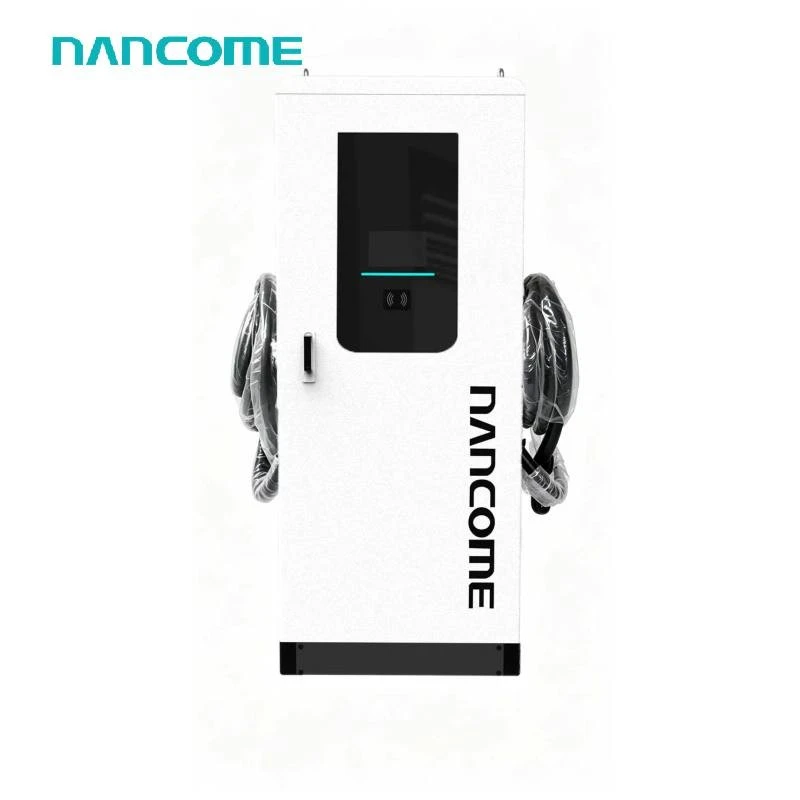
Our NEDF floor-mounted DC charging platform covers project configurations from 40 kW to 240 kW with a DC200–1000V output range. Available connector and communication configurations must be confirmed for the destination market and selected backend.
High-Power Charging
Compare our 180 kW DC charging station and 240 kW DC fast charger for higher-turnover sites.
Network Integration
Review configurable backend communication through our OCPP DC EV charger range.
Outdoor Projects
Evaluate enclosure, site temperature and installation requirements for an outdoor DC EV charger.
Commercial Sites
Match charger power and operating functions to a commercial DC EV charging station.
Fleet Deployment
Coordinate charging output with routes and departure requirements using a fleet EV charging station.
Power Management
Review how DC charger load balancing affects multi-connector site planning.
Buyer Questions
Global DC EV Charging Station Market FAQ
The main trend is the transition from standalone chargers to connected, site-managed charging systems. Buyers increasingly evaluate power allocation, backend integration, availability and maintenance together with charger output.
No. The appropriate power depends on vehicle capability, dwell time, daily demand and grid capacity. Many urban, destination and fleet applications can operate effectively with lower ratings or shared power.
A wide output-voltage range can support a broader selection of vehicle battery systems. Compatibility still requires checking the vehicle voltage, requested current, connector and communication protocol.
Requirements vary by project and market. OCPP is increasingly specified where operators need third-party backend integration, but the required version, security profile and functions must be stated in the RFQ.
Fleet charging is planned around vehicle routes, dwell periods and departure readiness. Power may be allocated according to operational priority instead of offering maximum output to every connected vehicle.
No. Megawatt charging addresses specific high-energy heavy-duty applications. Passenger vehicles, light commercial fleets and many depot operations will continue using lower-power DC charging.
Please provide the destination country, site power supply, charger quantity, required power, target vehicles, connector standards, installation environment, access method, backend, OCPP version, certification requirements and OEM needs.
Plan the Charging Site Around Vehicles, Power and Operations
Send us the destination country, vehicle types, charging schedule, available electrical capacity, required connector standards, charger quantity, backend requirements and expected expansion. We can review the appropriate DC charging configuration for the project.
Discuss Your DC Charging Project


