Vehicle Voltage
The charger must operate within the battery voltage requested by the vehicle. The DC200–1000V range covers compatible 400V and 800V platforms.

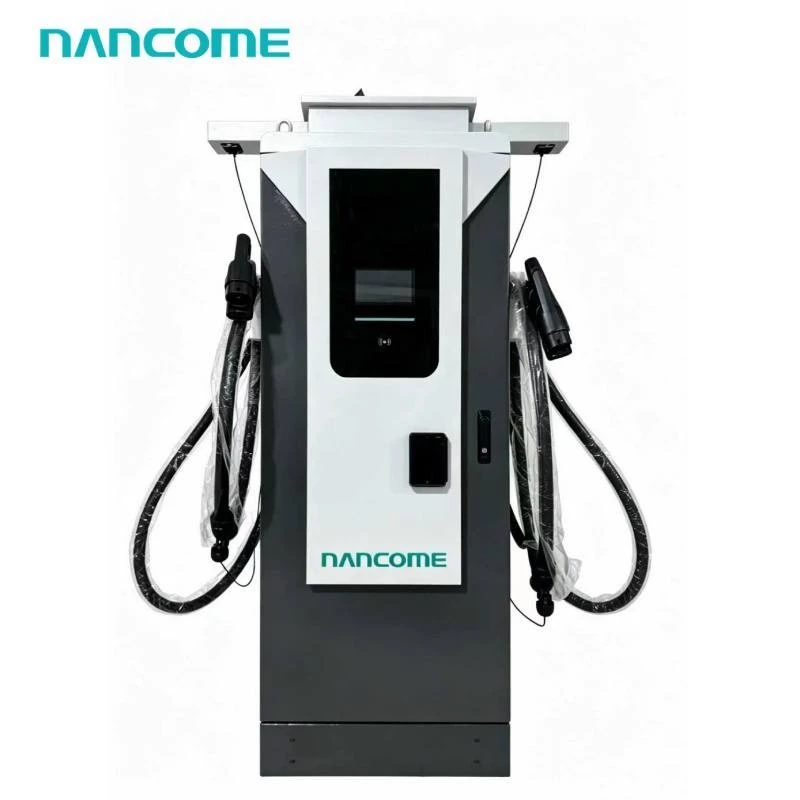
• CCS2 connector for European-market EVs • 40–240kW commercial power options available • DC200–1000V supports 400V and 800V vehicles • Single, dual or mixed connector configurations • Standard 5m cable with optional length upgrades • Optional liquid cooling for higher current demand • Optional OCPP supports backend integration
Our CCS2 DC Fast Charger platform provides 40–240kW floor-mounted configurations for compatible European-market electric vehicles. Its DC200–1000V output range supports varied battery platforms, while connector current, cable cooling and backend functions are confirmed for each project.
CCS2 identifies the vehicle interface; it does not determine the charging speed by itself. Real output remains limited by the charger configuration, cable assembly, vehicle charging curve and available site power.
Selecting a higher cabinet rating does not guarantee that every CCS2 vehicle will charge at that power. The lowest applicable limit controls each charging session.
The charger must operate within the battery voltage requested by the vehicle. The DC200–1000V range covers compatible 400V and 800V platforms.
The vehicle controls the voltage and current it accepts. Demand normally decreases as state of charge rises or thermal limits are reached.
The maximum current of the CCS2 connector and cable can limit power even when the cabinet and vehicle support a higher rating.
Transformer capacity, feeder sizing, other site loads and simultaneous sessions determine how much charger output can be used.
Selection rule: Check battery voltage and maximum charging current together. Kilowatt rating alone is insufficient for comparing CCS2 charger configurations.
The available NEDF floor-mounted platform can be configured with CCS2 charging connectors. Final current, connector quantity, power allocation, cable assembly and protocol functions are stated in the confirmed model specification.
| Category | Selection Item | Available Specification |
|---|---|---|
| AC Input | Voltage Range | AC380V ±20% |
| AC Input | Connection | 3P + N + PE |
| AC Input | Frequency | 45–65Hz |
| Electrical | Power Factor | ≥0.95 under normal output power |
| DC Output | Rated-Power Options | 40 / 60 / 80 / 120 / 160 / 180 / 240kW |
| DC Output | Voltage Range | DC200–1000V |
| DC Output | Series Output Current | 0–300A; final limit depends on configuration |
| Interface | Charging Connector | CCS2 configuration |
| Interface | Connector Quantity | Single, dual or project-specific configuration |
| Cable | Standard Length | 5m; optional length upgrade available |
| Cooling | Cable Cooling | Air cooling standard; liquid cooling optional |
| Environment | Operating Temperature | -20°C to 50°C |
| Environment | Storage Temperature | -40°C to 85°C |
| Environment | Humidity | 5–90% RH, non-condensing |
| Environment | Altitude | ≤2000m |
| Installation | Mounting Type | Floor-mounted; indoor or outdoor installation |
| Enclosure | Protection Level | IP54 |
| Management | Communication | Remote operation and service; OCPP optional |
| Customization | Project Support | OEM, ODM and project-specific configuration |
Configuration boundary: Not every listed power, current, connector and cooling option forms one standard model. We verify the complete combination before confirming an order.
Suitable where one vehicle uses the cabinet at a time. Confirm the required maximum current, charging-cable reach and expected vehicle inlet positions.
Supports two CCS2 charging positions. When both vehicles charge together, available cabinet power must be allocated between the sessions.
CCS2 may be combined with another supported connector standard when the location serves more than one vehicle interface. Compatibility must be checked per vehicle.
Dual-output check: Request the maximum simultaneous output and current for each connector. Do not assume that both vehicles receive the full cabinet rating.
The CCS2 cable assembly affects usable output and daily handling. Excess length adds weight and routing difficulty, while insufficient reach can make a correctly rated charger unusable in some parking positions.
Record the inlet position on every passenger car, van, bus or truck expected to use the charging bay.
Compare the standard 5m cable with cabinet position, parking direction and protective-barrier placement.
Use the required charging power and lowest operating battery voltage to estimate the necessary current capability.
Air cooling is standard, while liquid cooling can be reviewed for higher-current project requirements.
A CCS2 connector confirms the physical charging interface with compatible vehicles. It does not confirm communication with an operator's central management system. Backend requirements should be reviewed independently.
We recommend arranging backend testing before a larger rollout when the project depends on a third-party charging-management platform.
Configure power and connector quantity around peak arrivals, expected dwell time and the CCS2 vehicle mix using the site.
Moderate or high-power CCS2 charging can support visitors, employees and shared vehicles when matched to parking duration and grid capacity.
Use route schedules, return times, battery energy demand and simultaneous vehicle count to define required power per connector.
Higher throughput may require greater cabinet power, suitable cable current, simple access and adequate electrical capacity.
Charging power should reflect whether drivers stay for several hours or require a short charging stop before continuing their journey.
Where CCS2 and another standard coexist, state the expected demand on each connector and the required simultaneous charging behavior.
We use this information to review charger power, CCS2 cable current, cooling, connector allocation and communication requirements. Delivery terms are confirmed after the technical configuration, quantity and destination are established.
It is intended for vehicles equipped with a compatible CCS2 DC charging inlet. Confirm the vehicle's inlet, battery voltage and accepted charging power instead of relying only on its destination market or brand.
No. CCS2 defines the connector and charging system interface. Actual power depends on the charger rating, connector current, vehicle voltage, charging curve, battery condition and available site power.
Yes, the platform can be configured for single or dual CCS2 outputs. When two vehicles charge simultaneously, the maximum output per connector depends on the cabinet rating and ordered power-allocation method.
The available charger platform has a DC200–1000V output range, covering compatible 400V and 800V battery platforms. The exact vehicle voltage and current requirements still need to be checked.
Liquid cooling can be considered when the project requires higher charging current while maintaining manageable cable size and temperature. The decision depends on maximum current, duty cycle, cable length and operating conditions.
OCPP is available as an option. Provide the required protocol version, backend platform, network connection and operating functions so integration can be reviewed before production.
Send the destination country, vehicle models, battery voltage, accepted DC power, required charger rating, connector quantity, maximum current, site input, cable reach, OCPP needs, quantity and OEM requirements.
Send the vehicle list, battery voltage, accepted DC power, site supply, connector quantity, cable reach, charging schedule and backend requirements. We will review the appropriate CCS2 charger configuration.
Hot Tags: ccs2 dc fast charger, China ccs2 dc fast charger manufacturers, suppliers, factory
(0/10)