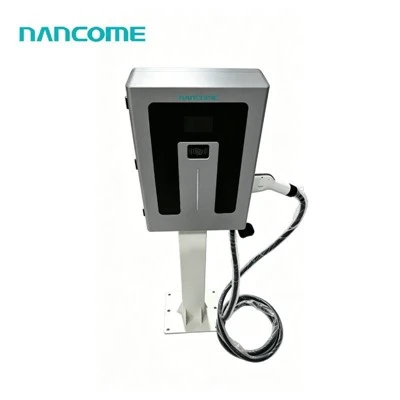
More Output Than 30–40kW
A 50kW configuration can shorten sessions for vehicles capable of accepting the additional power.


50kW DC output balances charging speed with moderate site power demand
Modular power architecture supports maintenance and project-specific configuration
CCS1, CCS2, GB/T and CHAdeMO connector options available
Seven-inch color touchscreen displays charging status and operating data
IP54 enclosure and IK10 impact resistance suit public charging locations
Remote diagnostics and firmware upgrade functions support easier operation
Logo, interface language, RFID and network functions can be configured
A 50kW DC Fast Charger is a practical middle-power option for sites that need faster charging than AC equipment but cannot justify a 120kW or higher installation. It is suitable for commercial parking, dealerships, workplaces, smaller fleets and distributed public charging points.
The charger performs AC-to-DC conversion inside the cabinet and adjusts output according to the connected vehicle's battery-management request. Actual charging power can be lower than 50kW when limited by the vehicle, battery condition or ordered configuration.
50kW is suitable only when the vehicle demand and electrical conditions support the intended operating plan.
The correct choice depends on vehicle acceptance, charging duration, daily traffic and the electrical capacity available at the installation site.
A 50kW configuration can shorten sessions for vehicles capable of accepting the additional power.
It may suit projects where available transformer capacity does not support a larger charger.
Workplaces, dealerships and commercial parking allow more dwell time than highway fast-charging sites.
Several moderate-power locations may provide better local coverage than one centralized high-power charger.
Items that vary by connector, destination market or ordered model must be confirmed in the quotation and technical datasheet.
| Category | Item | Available Specification |
|---|---|---|
| DC output | Rated power | 50kW |
| Product type | Charging method | Commercial DC fast charging |
| Power system | Architecture | Modular power-system design |
| Charging interface | Connector options | CCS1 / CCS2 / GB/T / CHAdeMO; confirm required configuration |
| User interface | Display | 7-inch color touchscreen |
| User interface | Displayed data | Charging time, voltage, current, power and operating status |
| Enclosure | Protection level | IP54 |
| Enclosure | Impact resistance | IK10 |
| Energy management | Standby function | Automatic sleep after charging; standby consumption stated as less than 5W |
| Maintenance | Remote functions | Firmware upgrade, power-module upgrade and diagnostic support |
| User access | Operation options | RFID and application functions available by configuration |
| Installation | Cabinet arrangement | Confirm floor-mounted or project-specific installation configuration |
| AC input | Site supply | Confirm voltage, frequency, transformer capacity and upstream protection |
| DC output | Voltage and current | Match to target vehicle battery platforms and selected connector |
| OEM/ODM | Available scope | Logo, cabinet appearance, interface language and user documentation |
Input current, exact output-voltage range, maximum connector current, cable length, payment functions and communication protocol require confirmation for the final 50kW model.
The charger does not continuously force its full rated output into the battery. The connected EV requests voltage and current according to its battery condition and charging curve.
Charge demonstration, service and delivery vehicles without installing highway-scale equipment.
Serve customers during shopping, dining or other visits with moderate vehicle dwell times.
Provide faster daytime charging for company vehicles, visitors or employees with compatible EVs.
Match charging to predictable return schedules and moderate daily energy requirements.
Offer DC charging where dwell time is longer but AC charging may be too slow.
Deploy moderate power where transformer capacity or traffic does not justify a 120kW charger.
The cabinet combines power conversion, vehicle communication, user operation, protection and remote maintenance functions.
Receives site AC power through the ordered distribution and protection configuration.
Convert AC input into regulated DC output for the connected vehicle.
Coordinates voltage and current with the vehicle battery-management system.
Displays charging data and supports the configured session-start method.
Supports diagnostic data, firmware updates and selected module-management functions.
The modular arrangement separates major functional sections for inspection and service.
Operating data can support preliminary fault identification before an on-site visit.
Automatic sleep activates after charging to reduce unnecessary standby power use.
A precise order specification reduces connector, electrical and software changes during installation and commissioning.
Send the vehicle models, connector standard, battery voltage, site supply, daily charging demand, quantity and software requirements for configuration review.
Provide vehicle types, connector standard, site input, quantity, destination and operating requirements.
Confirm output voltage, current, site capacity, cable arrangement and upstream protection.
Finalize access control, networking, cabinet design, interface language and technical documentation.
Confirm inspection, packaging, destination and local installation responsibilities.
A 50kW charger is suitable for dealerships, workplaces, commercial parking, hotels, small fleets and distributed public charging locations where moderate charging speed and manageable site demand are both important.
No. Actual power depends on the vehicle's accepted voltage and current, battery temperature, state of charge, charging curve and the charger's configured limits.
Available project options include CCS1, CCS2, GB/T and CHAdeMO. Confirm the destination market and target vehicles before selecting the connector.
The exact input voltage, current, cable size and protective devices depend on the ordered model and local installation. Provide the site supply and transformer capacity for engineering confirmation.
The referenced charging cabinet has IP54 enclosure protection and IK10 impact resistance. Local installation must still address foundation, drainage, incoming protection, ventilation and service clearance.
Remote diagnostic, firmware-upgrade and power-module upgrade functions are available on the referenced charging platform. Network and backend requirements should be specified before ordering.
Logo, cabinet appearance, interface language, user documentation, RFID access and selected software functions can be discussed as part of the OEM or ODM configuration.
Include vehicle models, connector standard, battery voltage, maximum accepted DC power, site input supply, installation environment, quantity, access method, network requirements, destination and OEM needs.
Send the vehicle models, connector standard, battery voltage, transformer capacity, daily charging volume, installation environment, quantity and software requirements.
Get a 50kW Charger QuoteHot Tags: 50kw dc fast charger, China 50kw dc fast charger manufacturers, suppliers, factory, 30kw ev dc gb t charger, Dc Charger For Electric Car with Cable, ev fast wall car charger box, gbt ev charge with credit card payment, home electric car charger ev charging station app, smart electric vehicle charging station
(0/10)