What An IP Rating Actually Tells You About An Outdoor DC EV Charger
Aug 14, 2026
Outdoor DC Charging Equipment
What an IP Rating Actually Tells You About an Outdoor DC EV Charger
An IP rating identifies how an enclosure resists access by solid objects and water. For an outdoor DC EV charger, it is an important enclosure specification-but it does not independently confirm corrosion resistance, impact strength, temperature suitability, drainage design or long-term performance at a particular site.

Reading the Code
How the Two IP Digits Work
The IP code uses two characteristic digits. The first describes protection against access to hazardous parts and the ingress of solid foreign objects. The second describes protection against water ingress under a defined test condition.
The classification is specified by IEC guidance on IP ratings. A higher digit indicates a higher test level within that part of the code, but buyers should compare the actual exposure test rather than relying only on the total number.
Solid-object protection
Dust may enter in limited quantities, but not enough to interfere with satisfactory operation under the specified test.
Water protection
Water splashing against the enclosure from any direction should have no harmful effect under the specified test.
Rating Comparison
IP54, IP55 and IP65 Are Not Interchangeable
The correct enclosure level depends on rain exposure, wind-driven dust, cleaning methods, drainage, shelter and local approval requirements. Specifying the highest available number without reviewing these conditions can add cost without resolving the site's main environmental risks.
| Rating | Protection against solids | Protection against water | Typical purchasing interpretation | Important limitation |
|---|---|---|---|---|
| IP44 | Protected against solid objects of 1 mm and larger | Protected against splashing water | May suit sheltered locations when permitted by the equipment specification and local requirements | Does not carry the dust-protected classification represented by the first digit 5 |
| IP54 | Dust-protected | Protected against splashing water | Commonly considered for outdoor charger cabinets with suitable siting, drainage and maintenance controls | Not dust-tight; not rated for water jets, pressure washing, immersion or flooding |
| IP55 | Dust-protected | Protected against water jets | Provides a higher declared water-ingress test level than IP54 | Still does not confirm suitability for powerful jets, submersion or every cleaning process |
| IP65 | Dust-tight | Protected against water jets | Useful where fine airborne dust is a more demanding project condition | Does not automatically confirm salt resistance, UV life, impact rating or thermal performance |
| IP66 | Dust-tight | Protected against powerful water jets | May be specified for more severe water exposure when supported by the charger design and certification | Does not mean the equipment is suitable for continuous immersion |
Site Assessment
When IP54 Can Be a Practical Outdoor Specification
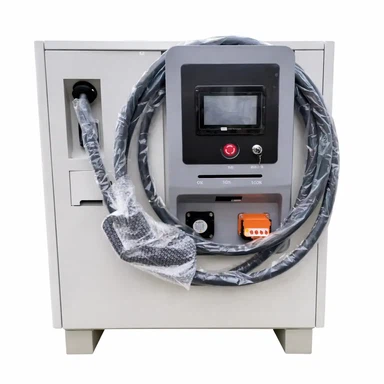
Newcom's NEDF 40–240kW floor-mounted DC charger lists IP54 protection and supports indoor or outdoor deployment. The same series lists DC200–1000V output, 0–300A output current and a standard dual-connector configuration. Final suitability still depends on the site and ordered configuration.
Commercial parking
IP54 may be considered where chargers stand on a raised foundation, surface water drains away and routine cleaning does not involve pressure jets.
Fleet depot
Review dust from vehicle movement, wash-bay proximity, cable handling, operating hours and whether trucks can splash water directly onto vents or doors.
Highway charging site
Open exposure, strong wind, de-icing chemicals, traffic spray and limited maintenance access may justify additional enclosure or site protection.
Covered charging bay
A canopy can reduce direct rain and solar loading, but drainage, wind-driven rain and water running from vehicles must still be addressed.
Coastal location
Salt-laden air creates a corrosion issue that an IP54 label does not resolve. Confirm cabinet finish, metal selection, fasteners and maintenance intervals.
Dusty industrial yard
Confirm dust type, concentration, filter access, ventilation path and inspection frequency. Conductive or combustible dust requires specialist assessment.

Foundation height, drainage direction, cable routing and service clearance affect outdoor charger reliability.
Beyond the Label
What an IP Rating Does Not Confirm
A charger can carry an appropriate IP rating and still be unsuitable for a project if temperature, corrosion, impact, ventilation or installation conditions fall outside its design limits.
Procurement Checklist
Information to Confirm Before Ordering an Outdoor DC Charger
- Installation exposure: open air, under canopy, beside a building or inside a ventilated enclosure.
- Water conditions: rainfall, wind direction, vehicle spray, irrigation, cleaning practice and flood level.
- Dust conditions: soil, road dust, sand, industrial particles and expected filter maintenance.
- Ambient conditions: minimum and maximum temperature, humidity, altitude and direct solar exposure.
- Corrosive conditions: distance from the coast, salt spray, industrial emissions and winter road chemicals.
- Installation details: foundation drawing, cable entry, drainage, ventilation clearance and service access.
- Electrical requirements: grid voltage, available transformer capacity, earthing system and surge environment.
- Charging requirement: required power, vehicle voltage range, connector standard and simultaneous charging demand.
- Compliance documents: applicable destination-market certification, test reports and labeling requirements.
Project planners can also review the site requirements in DC charger installation planning before choosing enclosure and cooling options.
Site data for enclosure selection
- Location: country, city and site type
- Exposure: sheltered or fully exposed
- Climate: temperature, humidity and rainfall
- Environment: coastal, dusty or industrial
- Cleaning: wiping, low-pressure rinse or water jets
- Power: charger rating and available grid capacity
- Layout: charger position, canopy and foundation
- Standard: destination-market requirements
Installation and Maintenance
Preserving Enclosure Protection After Delivery
The installed charger only retains its intended protection when cable entries, doors, seals, vents and service procedures remain consistent with the tested enclosure design.
| Control point | What the installer or operator should verify | Why it matters |
|---|---|---|
| Foundation and drainage | Use the specified base dimensions, keep cable entries protected and direct standing water away from the cabinet. | Reduces water exposure at the cabinet base and underground cable route. |
| Cable glands | Use compatible gland sizes and sealing components for every power, communication and auxiliary cable. | Incorrect or unsealed entries can compromise the enclosure protection. |
| Door seals | Check for compression, contamination, cracks or damage after transport and scheduled servicing. | A damaged gasket can create a direct ingress path. |
| Airflow path | Maintain specified clearances and replace or clean filters according to the equipment instructions. | Blocked airflow can raise internal temperature and increase stress on power modules. |
| Cleaning method | Avoid pressure washing unless the ordered unit and manufacturer instructions expressly permit it. | IP54 addresses splashing water, not water-jet cleaning. |
| Field modifications | Obtain approval before drilling, replacing vents, adding antennas or altering cable entries. | Unapproved modifications may invalidate the original ingress-protection design. |
Technical Resources
Continue the DC Charger Selection Process
Ingress protection should be evaluated together with output range, charging demand, cooling, connector configuration, electrical infrastructure and maintenance access.
Buyer Questions
Outdoor DC EV Charger IP Rating FAQ
Is an IP54 DC EV charger suitable for outdoor installation?
IP54 provides dust protection and protection against splashing water. Outdoor suitability must also be supported by the charger specification and confirmed against rainfall, drainage, temperature, cleaning, corrosion, ventilation and local installation requirements.
Does IP54 mean that the charger is waterproof?
No. IP54 indicates protection against splashing water under its defined test condition. It does not classify the enclosure for water jets, powerful pressure washing, immersion or flooding.
What is the main difference between IP54 and IP55?
Both have a first digit of 5 and are dust-protected. IP54 addresses splashing water, while IP55 addresses water jets. The project should specify the required exposure level rather than treating the two ratings as identical.
Is IP65 always better than IP54 for a DC fast charger?
IP65 declares dust-tight protection and protection against water jets, but a higher IP rating does not automatically solve heat dissipation, corrosion, impact, condensation or flooding risks. The complete charger design and installation environment remain decisive.
Can an IP54 charger be cleaned with a pressure washer?
Pressure washing should not be assumed to be acceptable. IP54 covers splashing water, not water jets. Follow the manufacturer's cleaning instructions and keep pressurized water away from doors, vents, displays and cable entries unless expressly approved.
Does an IP rating cover vandalism or vehicle impact?
No. Mechanical impact resistance is addressed separately, commonly through an IK classification. Charger placement, protective bollards and traffic circulation should also be considered for public and fleet sites.
What information should be sent when requesting an outdoor charger recommendation?
Provide the installation country, site type, climate, rainfall and dust exposure, charger power, connector standard, number of charging ports, grid voltage, available transformer capacity, layout drawing and applicable market certification requirements.
Match the Charger Enclosure to the Actual Installation Site
Send the site environment, required charging power, vehicle connector standard, grid conditions and project quantity for configuration review and quotation.
Project Inquiry
Outdoor DC Charger Configuration Request
Include the destination country, installation environment, required power, connector standard, quantity, grid voltage and any enclosure or certification requirements.