How are EV charging stations set up?
Jun 25, 2023
With the vigorous development of the new energy industry, electric vehicles are becoming more and more common in life. Automakers such as BYD, BMW, and Tesla have all rolled out all-electric vehicles, while hybrid vehicles are more common. In order to be able to easily charge the batteries of these electric vehicles, charging stations must be established. How to set up the charging pile? Let's take a quick look.
An electric vehicle charging station is mainly composed of three parts: power supply system, charger and monitoring system.
This power supply system mainly supplies power to the charger, mainly composed of primary equipment (switches, transformers, switching circuits, etc.) and secondary equipment (including detection, protection, control equipment, etc.), and is specially equipped with active filtering equipment to eliminate harmonics and stabilize the power grid.
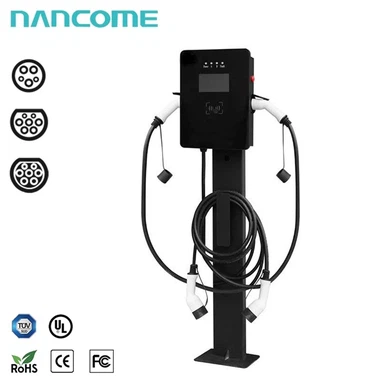
The charger is the core of the entire charging pile electrical system, which is usually divided into DC charging group and AC charging group. The DC charging stack, i.e., off-board charger, enables fast battery charging. The AC charging set mainly provides the function of slowly charging the vehicle. The output is AC and must be connected to the built-in charger.
A toll monitoring system consists of one or more workstations or servers, including monitoring workstations, data servers, etc. These computers are connected through a network. The monitoring workstation provides an interface for human-computer interaction charging monitoring to realize monitoring and charger data acquisition and query. The data server stores the raw data and statistical analysis data of the entire billing system, and provides data services and other application services.
Next, we will focus on power systems and chargers (AC charging stack and DC charging stack).
Power system standard requirements
1. Power requirements
1) The charging pile should operate at a voltage of 10 (20) KV.
2) AC rechargeable battery packs should operate at a voltage of 380 V or 220 V
3) The DC charging stack should operate at a voltage of 380 V.
2. Power quality requirements
1) The voltage deviation of the power supply should be equal to the voltage deviation of 10 (20) kV, and the subsequent three-phase power supply should not exceed the ±7 of the rated voltage. The voltage deviation of a single-phase 220 V supply must not exceed +7%, -10% of the rated voltage.
2) The frequency deviation shall not exceed ±0.2 Hz.
3) The harmonic voltage limit of the utility grid requires that the total harmonic distortion rate of 10(20)kV three-phase voltage is less than 5%, while the total harmonic distortion rate of 380V three-phase voltage is less than 4%;
4) When running at maximum load, make sure that the power factor of the 10 (20) KV side of the transformer is not less than 0.95.