

POS Terminal
Captures the supported card interaction and sends the authorization request through its configured payment route.

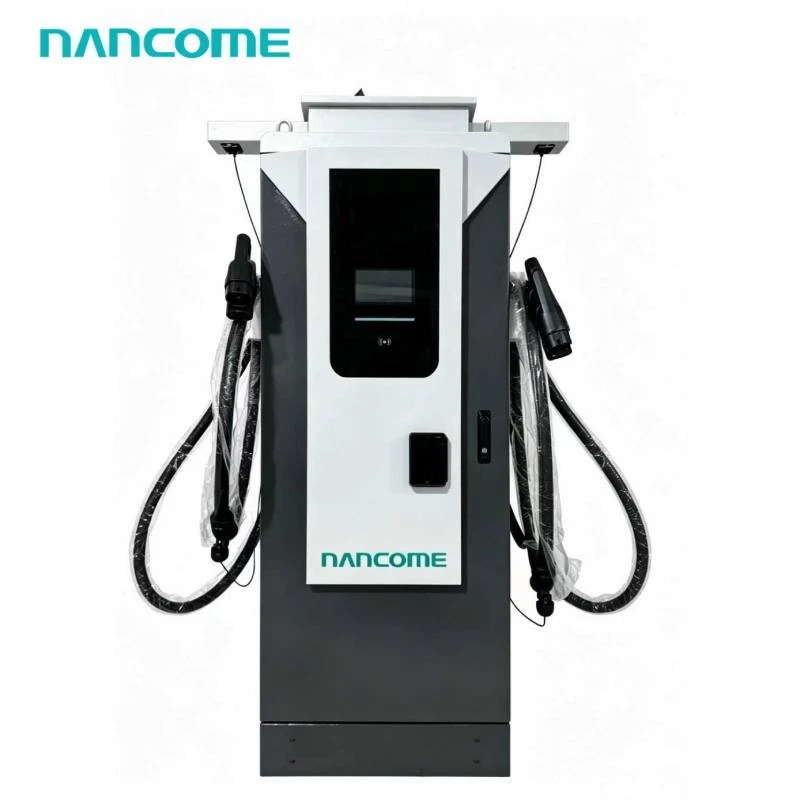
• Project-based POS terminal integration • Supports on-site contactless payment workflows • Links payment authorization to charging sessions • Optional OCPP enables backend communication • 40–240kW commercial configurations available • CCS1, CCS2, GB/T and CHAdeMO options • Terminal requirements confirmed by market
An EV Charging Station with POS Terminal combines DC charging equipment with a project-approved card-payment device and transaction workflow. It can provide an on-site payment route for public users without requiring every driver to hold an operator RFID card.
The POS terminal does not operate independently from the payment ecosystem. Its hardware, software, acquiring service, accepted cards, communication method and certification must match the destination market and charging platform.
A successful transaction requires the terminal, charger, charging-management platform and payment service to use consistent identifiers and exchange the required status information.
Captures the supported card interaction and sends the authorization request through its configured payment route.
Starts the approved connector session and records the supported charging and meter information.
Associates the payment authorization, charger, connector, tariff and final session record.
Handles the applicable authorization, capture, settlement, reversal or refund process.
The final technical schedule should list charger specifications and POS integration as separate scopes. Terminal availability depends on the selected provider, platform and destination requirements.
| Category | Selection Item | Available Specification |
|---|---|---|
| AC Input | Voltage Range | AC380V ±20% |
| AC Input | Connection | 3P + N + PE |
| AC Input | Operating Frequency | 45–65Hz |
| Electrical | Power Factor | ≥0.95 under normal output power |
| DC Output | Rated-Power Options | 40 / 60 / 80 / 120 / 160 / 180 / 240kW |
| DC Output | Voltage Range | DC200–1000V |
| DC Output | Series Current | 0–300A; final limit depends on configuration |
| Charging Interface | Connector Options | CCS1 / CCS2 / GB/T / CHAdeMO |
| Charging Interface | Connector Quantity | 2 standard; project options up to 4 guns |
| Cable | Standard Length | 5m; optional length upgrade available |
| Cooling | Charging Cable Cooling | Air cooling; liquid cooling optional |
| Payment | POS Terminal | Project option subject to terminal review |
| Payment | Card Methods | Defined by the selected terminal and provider |
| Payment | Authorization Model | Project-defined payment workflow |
| Payment | Currency and Tariff | Configured through the applicable platform |
| Communication | Charger Network | LAN / Wi-Fi / 4G by ordered configuration |
| Communication | Charging Protocol | Optional OCPP; version confirmed by project |
| Environment | Operating Temperature | -20°C to 50°C |
| Environment | Storage Temperature | -40°C to 85°C |
| Environment | Humidity | 5–90% RH, non-condensing |
| Environment | Altitude | ≤2000m |
| Installation | Cabinet Type | Floor-mounted; indoor or outdoor use |
| Enclosure | Protection Level | IP54 |
| Customization | Project Support | OEM, ODM and project-specific configuration |
The terminal position affects usability, cable routing, enclosure work and maintenance. Confirm the physical arrangement before cabinet production.
A terminal installed on the charger requires confirmed dimensions, cut-out, fixing, cable route, environmental suitability and service access.
A separate terminal may serve one or more chargers. The project must define charger selection, connector identification and walking distance.
A shared arrangement needs an unambiguous method for matching each payment authorization to the correct charger and connector.
Review mounting height, screen visibility, approach space and applicable accessibility requirements for the destination site.
Confirm that the selected terminal and its installation method are suitable for the site's rain, dust, sunlight and temperature conditions.
Leave access for terminal inspection, communication checks and replacement without unnecessary disturbance to high-voltage equipment.
Hardware installation, merchant onboarding, acquiring, software integration and ongoing transaction support may involve separate organizations.
No standard terminal should be assumed. The required model, payment provider, card methods, communication, cabinet mounting and destination-market approvals must be confirmed before quotation.
Contactless acceptance depends on the selected POS terminal, payment provider, acquiring arrangement and supported card networks in the destination market.
A shared-terminal arrangement may be possible when the complete platform supports it. The user must be able to select the correct charger and connector without ambiguity.
The applicable platform applies the configured energy, time, session or combined tariff to the accepted charging record. Pricing methods must comply with local requirements.
The payment workflow may use a pre-authorization before the final charging cost is known. The amount and release timing are determined by the payment and acquiring arrangement.
Offline payment capability depends on the terminal, provider and risk policy. Required offline limits, stored records, recovery and reconciliation behavior must be confirmed separately.
Send the destination country, POS model or provider, acquiring bank, required card methods, currency, tariff, pre-authorization rules, receipt requirements, OCPP platform, network method, charger power, connector standard, quantity and OEM needs.
Send the target terminal, payment provider, acquiring arrangement, card methods, currency, tariff, OCPP platform and charger configuration for integration review.
Hot Tags: ev charging station with pos terminal, China ev charging station with pos terminal manufacturers, suppliers, factory
(0/10)


