7kW, 11kW, 22kW, How To Choose A Home Charging Pile?
Dec 05, 2023
As "buy a car and send a pile" gradually becomes a thing of the past, many car owners need to buy home charging piles by themselves, compared with the original charging piles with "small and expensive" prices, everyone began to look at third-party brands such as Newcome Electric, but new problems also followed, only in terms of charging power, There are three types of 7kW, 11kW, and 21kW to choose from, so do you know which one is suitable for your car? Today, I will teach you how to choose a suitable home charging pile~
Look at the car first
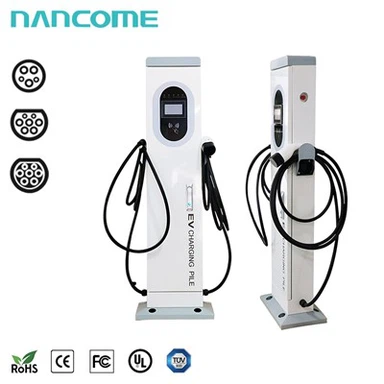
The charging power determines the charging speed, but different new energy vehicles support different charging powers. Therefore, when choosing a home charging pile, you should first have a general understanding of your car. Generally speaking, our new energy vehicles often have two charging interfaces, one is the AC charging interface (seven holes), and the other is a DC charging interface (nine holes), which refers to the household charging pile, mainly referring to AC charging piles.
Its charging process is also very simple, that is, the alternating current in the power grid is input into the on-board charger at the vehicle end through the charging pile, and through the on-board charger, it is converted into the direct current required by the power battery. Therefore, the maximum charging power that can be accepted by new energy vehicles is not determined by the power at the pile end but is limited by the specifications of the onboard charger.
Specifically, there are two kinds of civil electricity: single-phase 220V and three-phase 380V, and the recommended value of the national standard for current is 10A/16A/32A/63A, and it is stipulated that single-phase charging and current shall not exceed 32A. Therefore, the maximum charging power of a 220V single-phase battery is about 7kW (220V×32A), while the minimum power of a three-phase charge is about 11kW (220V×16A×3). If the onboard charger only supports single-phase electricity, even if an 11kW charging pile is installed, it can only get about 3kW of charging power (220V×16A), which is not as fast as a 7kW charging pile.
Then select the pile
After understanding the difference between the car end, let's look at the pile end, which is easy to understand. Depending on the specifications of the onboard charger, the voltage platform to which it adapts is also different. For 7kW charging power, you can apply for a 220V meter. For charging power of 11kW and above, a 380V meter is required.
However, due to the capacitance problem, not every community supports the application of 380V meters, and Star friends need to communicate with the local power supply bureau and the property in the community in advance to confirm. Because of this, if conditions permit, it is recommended that you apply for a 380V meter first.
So chosen
Of course, when buying a third-party charging pile, in addition to choosing the right power, the brand of the charging pile is also very important. A good brand means better product quality, smarter product functions, and better after-sales service. Don't blindly pursue "low prices" and ignore the hidden dangers behind them.
It is recommended to choose a third-party brand with independent R&D and production capacity, and a complete after-sales guarantee system. At the same time, even in the case of the same power, the charging piles of third-party brands are not the same in terms of functional quality.
If you are looking to purchase a car charging station, please feel free to contact us. Nankong Electric Technology Co., Ltd. has more than 30 years of rich experience in the field of electrical manufacturing. As a reputable supplier, we firmly believe in providing you with high-quality services. If you have any questions or need a quote or cooperation, please contact us by email or the inquiry form below. Our sales representative will get back to you within 24 hours.
Our Home-Car-Charging-Station