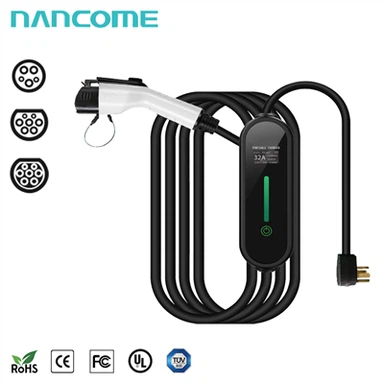
Detailed explanation of AC electric vehicle charging stations
Jul 03, 2023
What is an AC EV charging station
AC electric vehicle charging station is similar to the fuel dispenser in the gas station, can be fixed on the ground or wall, installed in public buildings (public buildings, shopping malls, public parking lots, etc.) and residential parking lots or charging stations, according to different voltage levels for various models of electric vehicles charging. The input of the AC electric vehicle charging station is directly connected to the AC grid, and the output is equipped with charging plugs for charging electric vehicles. AC electric vehicle charging station generally provides conventional charging and fast charging two charging methods, people can use a specific charging card in the AC electric vehicle charging station provided by the human-computer interaction operation interface to swipe the card, the corresponding charging mode, charging time, cost data printing and other operations, AC electric vehicle charging station display can display charging amount, cost, charging time and other data.
Since the first electric car in the 19th century, rechargeable batteries have been used as their power source. For an electric vehicle, battery charging equipment is one of the indispensable subsystems. Its function is to convert the electrical energy of the grid into the electrical energy of the on-board battery of the electric vehicle. There are different methods for the classification of electric vehicle charging devices, and in general, they can be divided into on-board charging devices and non-on-board charging devices.
On-board charging device refers to the device installed on the electric vehicle using the ground AC power grid and on-board power supply to charge the battery pack, including the on-board charger, the on-board charging generator set and the running energy recovery charging device, and plug a plug AC power cable directly into the charging socket of the electric vehicle to charge the battery. On-board charging devices usually use contact chargers with simple structure and convenient control, or they can be inductive chargers. It is completely designed according to the type of vehicle battery, and it is highly targeted. Non-vehicle charging devices, that is, ground charging devices, mainly include special chargers, dedicated charging stations, general chargers, charging stations for public places, etc. It can meet various charging methods of various batteries. Generally, the power, volume and weight of non-on-board chargers are relatively large, so that they can adapt to various charging methods.
In addition, according to the way of energy conversion when charging the electric vehicle battery, the charging device can be divided into contact type and inductive type. With the rapid development of power electronics technology and converter control technology, the maturity and popularization of high-precision controllable current conversion technology, the phased constant current charging mode has been basically replaced by the constant voltage current limiting charging mode with continuous changes in charging current and charging voltage. The charging process is dominated by the constant voltage and current limiting charging mode. The problem with contact charging is its safety and versatility. In order for it to meet strict safety charging standards, many measures must be adopted on the circuit to make charging equipment safe charging in various environments, constant voltage current limiting charging and staged constant current charging are contact charging technologies. New inductive charging technologies for electric vehicles are developing rapidly. The induction charger is a transformer principle that uses a high-frequency AC magnetic field to sense electrical energy from the distance away from the car to the auxiliary side of the vehicle to achieve the purpose of charging the battery. The advantage of inductive charging is safety, because there is no direct point contact between the charger and the vehicle, even if the vehicle is charged in harsh climates, such as rain and snow, there is no risk of electric shock.